
Surprised and supported by a poem
Plus a video of mustering sheep!

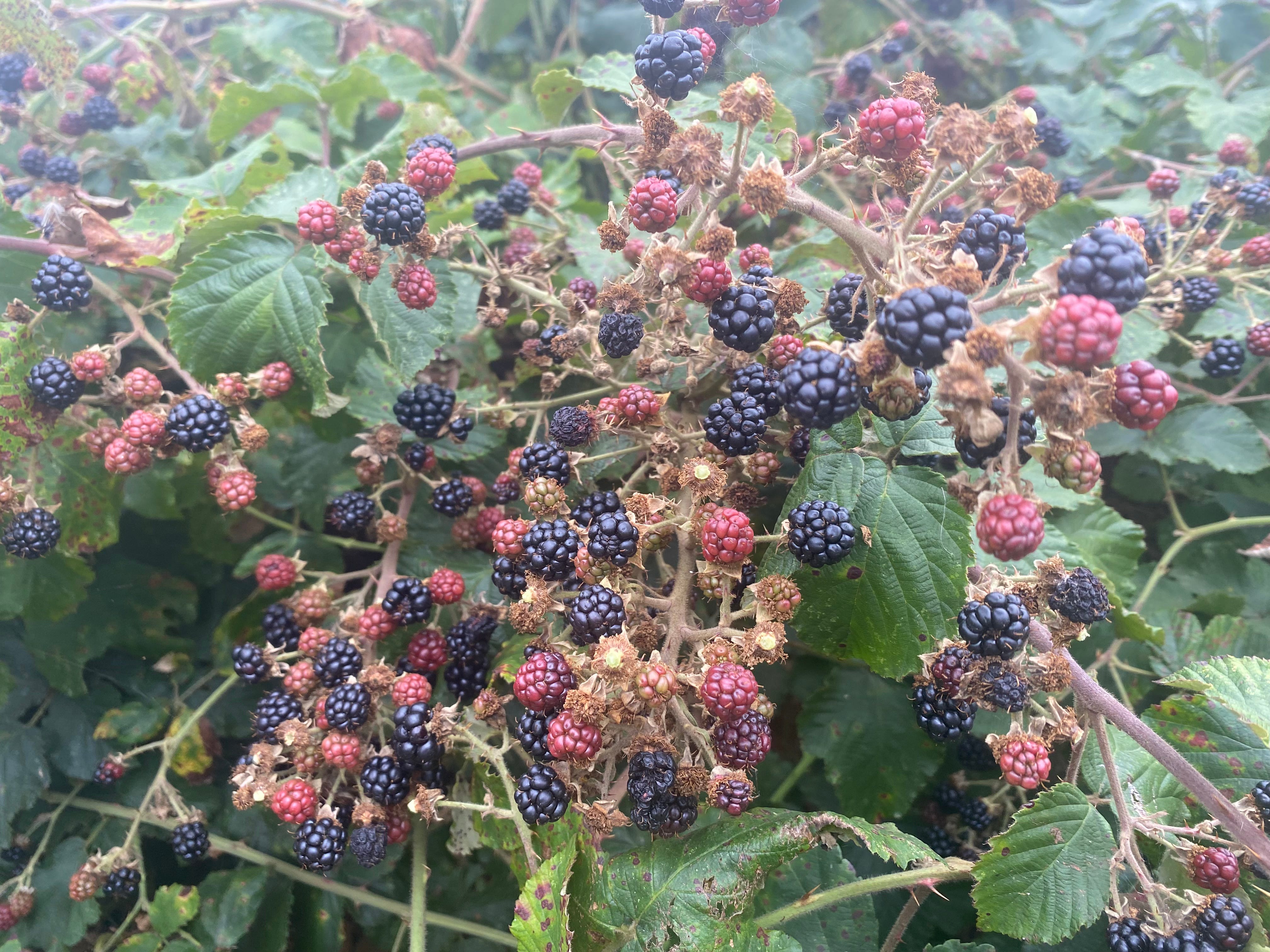
The last few days have been Surprised by a Poem preparation time. SBAP is an online writing and movement workshop series that I’m teaching with Sue Rickards over six weeks in the autumn. And while autumn is still a month or so away here in the Northern Hemisphere, we have reached the harvesting part of summer. Mostly this has involved me picking blackberries and trying to work out how to pick the runner beans that have run half-way up the back of our house. Thinking about poems, and how they come about - how they seed/get planted, how they grow, their harvest.
I’ve been flicking through old drafts of poems, saved alongside the corresponding feedback notes from Tideway, the poetry group I’ve been a part of for over a decade. I’ve been reading our notes from when we last ran SBAP and have been dancing in my living room - gently, slowly, stretching into sinew and muscle, sensing my bones. I’ve been asking my body, what do you have to say about this? Picking poetry books off the shelf at random, returning to old favourites, reading new work. Casting my net wide and reflecting on how I came to writing poems in the first place.
Back in the mid ‘00s I was working on a novel set in NZ in WW2, and its aftermath. Even now I feel a bond with the characters - a young woman who falls for a GI but then marries a farmer back from the war. It was loosely based on the many stories great-aunts and uncles told me, supplemented by research at the National Library and interviews with people. I loved the conversations and the research but it got to the point where I realised I wasn’t good at all the cross checking needed for a historical novel, found the sheer unwieldy size of it all a bit daunting. The writing was ok, but it felt cumbersome to me, like I could never find my groove.
Then in 2008 I joined Jane Draycott’s monthly Saturday poetry workshops at The Poetry School. I’d written poems before, often for people as a gift to mark something - a wedding, a birthday, a relationship. This, however, was my first time I’d received consistent feedback regarding my own work. The structure of each morning went like this: we’d read and explore a published poem and do a writing exercise out of that. Then each person would have 15 minutes to read their poem and receive feedback from Jane and the group. The rule was that for this 15 minutes, apart from reading their poem, the poet didn’t contribute or comment, even if the group had misunderstood something in the poem, or were right off track. Their job was to listen.
These workshops taught me so much, not just about my own work, but also about how to structure and offer feedback in a way that is nutritive and productive. That brings out the best in the poem. Just as importantly it taught me how to receive feedback, to let go of the poem (or any created piece of work) and let it stand on its own two feet, separate from me. A vital step in any creative act.
Jane was an incredible guide at this, her ability to see and hear what a poem was trying to do, and helping it do more of that. She created a group that respected what each person writing was working towards, even though stylistically we were very different. Her way of teaching has greatly influenced me as a manager and leader of people, and as a workshop facilitator. It also formed the base of how we structure Tideway, our ongoing poetry group, a tributary of those workshops.
The first poem I took was three pages! It covered so much material, mostly about my brother and the line of farmers and dog trialers he is descended from; I was interested in what gets passed down and how. I’d just been back to New Zealand and had stayed with Matthew who was shepherding on a Wairarapa station. As I watched him work his dogs it felt at once familiar but also very far from my London life.
Most of those pages got cut, but not before Jane introduced me to the idea that good lines and ideas might have a home somewhere else, that nothing is wasted, and that you can keep it in a drawer for later. I’ve since used the opening line from that piece in another poem. But what the group felt was working, and through their suggestions got set free, was a few lines at the end, which became their own poem:
Muster
- for Matthew

Early morning you move the mob,
ripple of pouring cream
down the side of a hill,
bolt of silk gathered and pulled
through the eye of a gate,
the dogs a streak of black
turning a paddock of sheep
into a river.

To you it is everyday,
to me it could be magic.
You muster sheep, I muster words -
paddock to yard, draft after draft.

Where are my dogs?
With that poem I felt like I’d found my medium. I let go of writing my novel (a half finished draft is in a drawer, it might compost into something different). I realised I found it much easier when I could see all of what I was working on one page. No matter what the material I was grappling with - whether something personal, or an idea that felt like wrestling with a fish - there was something deeply reassuring to me about seeing the four edges of the page, the container.
I fell in love with the specificy of language writing a poem requires - because every word counts, those words matter. Which still feels to me like a deep paying of attention, a naming and noticing of the world and us.
I’ve learnt how to get out of the way of the poem. Sometimes this means cutting away the ‘warm-up’ bits at the beginning, or things that feel important to me personally but not might belong in this particular poem. And also the exact opposite, of finding out that a piece actually needs to be bigger, or longer, that the poem has much more to say that I had originally thought.
At the end of this piece there is a video of Matt bringing a mob of 6500 ewes into the Tautane Station yards.
Poems as medicine
The poem below was both a surprise and a support, and is an example of what can happen when you combine movement with writing. I was on a residential Open Floor workshop that Sue was teaching in Belgium. One afternoon I was on the dance floor, overcome with shame about something old that had come up, something much deeper than embarrassment, something about which I didn’t know how to tell another person. Overcome, but also deeply supported by the music, and Sue’s voice guiding us.
There were large doors that opened out onto a deck, and beyond that woods and farmland. To one side there was a large old sycamore tree with a hollow at its base. As I moved from inside to outside, moving this sense of something I can only describe as revulsion, I had this reoccurring image of an old woman sitting at the base of the tree - ancient and ageless, warty and barefooted, chewing on bones. A big cauldron in front of her. I let in the chink of possibility that maybe I could tell her of this shame, that I could tell this imaginary figure who was at once deeply personal and archetypal. So I did, and she answered with this poem which went through a few drafts to fine tune it, although her voice was clear from the start.
Enough


She sits in the hollow of the sycamore,
pot on the fire, holding a spoon

older than the oldest tree.
Wrinkled, wide-hipped,

her laugh is all belly.

Bring it to me, she says, bring it all,
all that you've been holding

tight - the beliefs, the shame,
the fear that binds you -

I eat it for breakfast.

Bring me the old untruth
that you are not enough.

It's all food for my pot.

I've seen it, a thousand,
thousand times.

Come, sit with me and stir.
Sometimes our bodies and psyches know the medicine we need, and that medicine in turn becomes medicine for others. May this one give some sustenance for days when any part of you feels that you’re not enough - for we’ve all been there. This poem helped me untangle the belief that I was the only person ever to feel this way. Her pot felt like it could hold whatever I brought, which made me realise, over time, that I too could hold it, that I could talk to another person.
Poem as medicine.
Surprised by a Poem is for people who’ve never written a poem, and for poets keen to come at their work from another direction, to see how moving the body might shake up and invite in new ways of seeing, hearing and writing. It’s for people who’ve never been part of a dance or movement group, as well as those for whom putting the body into motion to music is deeply familiar. There will be the chance to dance, to write, to rest and write again. You can bring your dinner (or breakfast depending on your time zone). There will also be the chance, over the 5 weeks, to work with me 1-1 in a break-out room, to spend some time looking at your poem together.
Sue will often say ‘Welcome’ at the beginning of any class she’s teaching. It’s so genuine that welcome, you feel it in your bones. And it’s here for this.
Surprised by a Poem - A five week online workshop
Dates: Wednesday October 29th, November 5, 12, 19, 26
Time: 6-8.30 UK time
Pricing: £220 regular income, £250 generous rate - this enables us to support others, £200 lower income, 2 places @ £40 if the cost would otherwise be prohibitive.
To book please contact Bronia onemomentintimetheatre@gmail.com
And to finish, a video Matt made about a decade ago, of him bringing in a mob of sheep into the Tautane Station yards.
This is beautiful Rachel, and deeply inspiring and authentic.. your writing and expression here has been a teaching for me. Huge gratitude..🙏
I so much enjoyed these memories of Jane’s group, but also the wisdom and inspiration of the rest of the piece - and looking forward to that recipe!